Elle Angeles

The biggest room is the room for improvement
Never Say Never
Believe

Tuesday, November 26, 2013

Theater Log Book Term 2

In preparation for our political protest, my group and I decided that we would perform our protest in the foyer, where it is usually busy during certain hours of the day. Then, we wrote multiple questions in which we would later hold up during our protest. Some of the questions were: 'Would you sit next to me on the train', 'Would you trust someone dressed like me', and 'Would you marry someone like me'. Additionally, we came up with the idea to join ourselves to each other with a piece of string as a metaphor that we are all the same. We also then printed out several pictures that had a relation to the way we were dressed, this way when people were in contact with out protest, they would be able to understand even more who we are portraying ourselves as. Here are some pictures of how me and another group member were dressed, with an item or piece of clothing representing another culture.
Representing Culture.

Evaluation of Political Protest


What went well in the protest?: During our protest my group and I engaged with the public very well, as we included audience interaction and direct address towards the public, however, I did notice that sometimes the public would sometimes try to ignore contact when they are approached, probably because they thought that it seemed slightly weird. This reaction reminded me of Brecht's verfremdungseffekt, because the public seemed to have been confused with the idea, however it left them with questions which as a result left some of them wanting to engage and communicate to find out more. Additionally, another thing that I noticed during our protest was that the clothing we were all wearing had a strong effect on what the public thought of us. I noticed that it drew their attention towards us, and in fact they wanted our attention to take photos and ask us questions. This attracted people and it allowed my group and I to protest. In many ways the public being attracted to our costume related to our theme of protest which was 'against culture stereotype', as people tended to stare at us because of how we were dressed which was what we were protesting against,(judgement, inequality, stereotyping) because overall we are all just human. Furthermore, my group and I came up with a sentence that goes against stereotyping and judgement, which we expressed vocally together at the same time. The sentence we spoke aloud was 'Under the clothes, the hats, the cloth, we are all one body'. This caught everyone's attention which made them more attentive to listen and understand what we were trying to project to everybody. Lastly, another thing that worked well in our protest was the usage of posters and signs with questions. Once the public had read a question from each of us, they had an option to stick 'yes' or 'no' on us depending on whether they agreed with the statement or not. The Brechtian technique of audience interaction worked well in our protest because, the public seemed much more interested and were willing to find out more about our protest.

What didn't go so well in the protest?:  Something that didn't go so well in our protest was that some of the audience tended to walk away when I addressed them directly, so at times it was hard to get some people's attention. However, from this I learnt that people actually tend to avoid protests when there is just lots of shouting at the audience, therefore it has to be done in a way where the audience can take time to observe and acknowledge what we are protesting for/against, and then a member of the public can then be approached. Furthermore, the use of being connected with each other with the string had it's positives but on the negative side, it was hard for us to move around without the string tightening, so it sometimes caused us to lose some focus. Also, we had an idea of playing music that related to our cultures that we were representing, however as we were in a busy and quite loud area, the music didn't reach as far as we had wanted. On the other hand, we always acknowledged what we were aiming for and didn't let negatives rule the performance.
What could be improved?:   The things that we could have improved on in our protest was being a bit more organised. We could have done this by maybe having a few more meet-ups to talk about our ideas towards the protest. This links to the fact that our protest at times didn't have a stable structure, however from this I learnt that protests are not always necessarily structured how planned, because there is a public entitled to their own reactions and opinions therefore it could go either good or bad. Despite the fact, it could have improved if there was some sort of routine that we could follow so things would be slightly more organised. Backing the previous point, this reminded me of how Bertolt Brecht structured his performances as he enjoyed the idea of not having a linear structure in a performance. Lastly, I think that our protest could have included a more theatrical vibe towards it. With these things included properly in our protest, it would have improved lots more and probably would have been slightly more effective for us and the public too. 

Overall, we performed our protest well and included Brechtian ideas towards it like audience interaction. I learnt that when trying to get a point across, people will try to avoid contact or feel out of their comfort zone, this is similar to Bertolt Brecht's ideology because during performances, he didn't want the audience to sit in comfort and enjoy a performance behind a fourth wall but he rather wanted them to be left with questions and thoughts and he wanted them to be included. As a group we combined our ideas together and included many different ways of getting our protest publicized to the audience in an interesting way which captured our attention, so overall it was a success and I have realized how different people can react to certain things, so I've learnt lots from this experience.


Theatre Log Book Term 2

Here is a link in which I found that shows a brief description of what Marxism is, and where Karl Marx developed his Marxist ideology.

Additionally, I found another video in which it briefly shows describes the morals of socialism, in a fun animated way! Brecht shared some of the same views of socialism, however many people argue that socialism sounds like a great theory but in reality it is unsuccessful.

Monday, November 25, 2013

Theatre Log Book Term 2


Brecht was a left wing Marxist. The Term Marxism came from a man called 'Karl Marx', and it is the similar belief to socialismRed flag waving.svg which states that there should be no hierarchy in society which may prevent someone's equal share in wage, especially for the working class which it is believed that the capitalist society takes their ideas and makes it their own leaving them with nothing. Brecht was against anything that reinforces the capitalist laws.

Capitalism - They believe in the business cycle, that you should be able to keep what you earn and it shouldn't have to be shared out with anyone that doesn't work for their own money. This could be argued however, that due to environment, not everyone will get the same life chances/opportunities.

Brecht's 'Verfremdungseffekt' relates to the Marxist ideology because, it almost foreshadows the situation that the working class were separated in class caste because of capitalism. Brechtian theater highlights the idea that the actor is separated from the character, and this is shown by alienating, or doing something unusual. Marxism suggests that the significant creation of human nature is creativity. He said that 'The work produced by man is not yours', e.g someone else more powerful owns your own creation. Therefore, he believed that the working class should rise up and abstain against capitalism together.
Brechtian's technique is very much political which relates to Marxism in many ways. Relating back to the idea that Karl Marx believed the working class should stand and rise together, Bertolt was against the emotion exchanges between audience and actors. Bertolt Brecht wanted his style of Theater to leave the audience with questions and to make them think for themselves. He wanted them to leave thinking that if you want something you should rise up and go for it, instead of sitting in a traditional theater coming to watch a show leaving the audience feeling sorry for themselves as to why their lives aren't perfect like the show. This also relates to the fact that Brecht was against plots in stories, because real life isn't planned out in a sequence, but instead theater should be 'epic'! Again, this all relates to another fact that Bertolt was against bourgeois- which is the belonging to or characteristics of the middle class, typically with references to it's perceived materialistic values or conventional attitudes.    

Bourgeois use over time.

Contrary to this, Brecht challenged Aristotle's ideas (a Greek philosopher) whom believed that good theater should have unity of time and place. Also, he believed that they should all have a linear structure.   
Aristotle
Aristotle's ideas lasted until the 20th century. These ideas are more or less the naturalism technique which Aristotle believed in. And he says that the audience have to suspend their belief to be able to engaged and believe in the story. Brecht challenged this idea of theater and he 'believes theater should be epic', meaning non-linear , with scenes that don't effect another scene therefore they all have their own story. Brecht believed in breaking down the fourth wall and sustaining their disbelief. The way Brecht achieved this was by: being harsh (no technological effects during performances, everything is done by the actors), he did things opposite to traditional theater, (such as alienating the audience), he used projections (where the actors may read out stage directions, or even describing what they are acting), direct address was used, distancing (so the audience remembered that it was always just a performance), he also included themes that related to everybody (opposite to bourgeois), he also blurred the boundaries between life and theater, leaving the audience with questions at the end of a performance.
      

Tuesday, November 19, 2013

Theatre Log Book Term 2 - November 19th 2013

Today my group and I decided to change the structure of our short Brechtian style theme, as before there wouldn't have been much variety to our performance. Therefore, we came up with the idea of keeping the speed dating but basing on the famous TV show 'Take Me Out'.

We were told that we need to include a piece of music in our performance and also include the idea of a silent scream. Therefore, we decided that we could combine these two ideas together and when 'Adolf' (Danny) comes into the scene, 'The Imperial March' theme tune would play, and at that point 'Anne Frank' (me), 'Gay' (played by Esme) and 'Black' (Eleanor) would all scream silently as if we look up to 'Hitler' (which we do in the performance as we all want to date him).

In addition, we had to include spoken sentences or phrases in our performance, 3 of which are: 'Let the sausage see the roll', 'No likey, no lightey!' and 'I'm Anne Frank'. It is important that the audience understand what we are trying to get across or trying to make them think.

The 10 main points that take place in our performance is:

  • The presenter (Maya) introduces 'Adolf Hitler'.
  • The other girls (played by Maya) turn off their lights, connoting they are not interested in 'Hitler'.
  • One of the girls say why they chose to turn their light off and 'Anne Frank' says why she kept her light on.
  •  Round two of the dating show, the remaining three girls get to ask 'Adolf' a question each.
  • 'Hitler' then gets all the power in his hands and gets to turn off one of the girls lights.
  • 'Black' then gets eliminated from the show and a cue lady (Esme) holds up a sign saying 'Clap now'.
  • The two remaining girls of the show 'Anne Frank' and 'Gay' get to say something about themselves and the presenter says that one of the remaining girls are in fact Jewish.
  • 'Anne Frank' says that she believes that Jewish people should also have equal rights, and the cue lady (now played by Eleanor) holds up a cue card saying 'Boo Now'.
  • 'Hitler' then gets to eliminate one of the girls. He chooses to eliminate 'Gay', and leaves 'Anne Frank' as his final choice.
  • It is then revealed by the presenter that 'Anne Frank' was the Jewish female out of the two, and then 'Adolf Hitler' and 'Anne Frank' leave the show happily to go on a date to the Island of Fernandez.

To portray the Brechtian style of acting to our performance, it is important that there are significant props and costume in our performance. At this stage we haven't decided on any specific props that we want to use in our piece, however we have acknowledged that we will be using props, in order to make our performance more complete. Additionally, there has to be direct address to the audience. This way, the audience will be reminded that they aren't just viewers of the show but will be shocked to know that they may be taking part. This is the idea that reminds the audience that there is no fourth wall between the actors and the audience, allowing them to remember that what we are doing is not reality, and we are trying to get a certain message across. We have to be able to show the audience that we are just actors, and this can be done by strange making, which may include speaking stage directions, demonstrating characters, changing costume on stage and multi-rolling during the performance. These Brechtian style techniques will break the barrier between the audience, and will also show them that there aren't limits as to how Theater can be shown, as it doesn't always have to be done the traditional way.

As a group we spoke about different ways that we could create the 'Verfremdungseffekt' in our performance. Some ideas we discussed were, having physical contact with the audience, taking their belongings, leaving the audience alone in the room in darkness, or including an actor in the audience.
One idea that we came to the conclusion of is adding a song to our performance at the end. This probably would confuse the audience as they wouldn't usually expect us to randomly start singing at the end of our performance. We then decided that during the song, we would gradually walk out, and include the idea of leaving the audience alone in the room with only the three actors on stage. These ideas combined is a great way of showing the Brechtian technique, which should have a 'Verfremdungseffekt' on the audience.

Theatre Log Book Term 2 - November 18th 2013

Today we were put in groups and focused on ideas that we could protest for or against, which we would later then base our future site specific performance on.

Linking it to politics, my group and I decided to focus our protest on going for different cultures/heritage fashion which is going against the idea of how people sometimes judge others on the way they dress which could depend on their heritage/culture.

Therefore, we came up with the idea that each person from our group would bring in different clothing that represents a certain country or culture. We decided that we would show this site specific performance in main foyer, where there are frequently a lot of people, therefore our performance would be noticeable.

From doing this I understand how the Brechtian theme links to our protest, as we are creating a protest for or against something, in a way that will be surprising to the audience, which will should capture their attention to see what we are trying to inform them.


Saturday, November 16, 2013

Theatre Log Book Term 2- November 12th 2013

Today we all shared a political story with the class which we had researched and pick a song which related to race and immigration.

I found an article written by Susan Brown who believes in the far right wing ideology, and the song I chose was '99 problems' by Jay-Z which has some lyrics in it as to why he used to get targeted by cops because of his heritage.

The term far right or extreme right is the ideology that agrees with social inequality and social hierarchy which is the opposite of liberalism and socialism. Far right consists of the 'neo-nazis' and fascists.

Here is a conclusion from the right wing article that I had found:


"We see this today with politicians in Washington who believe that a big government is the cure all for everything that aids its nation. They believe government, by way of forced charity, should do for us what we should be doing for ourselves and each other... Of course, none of this matters to liberals who are good at legislating go-good policies that fail terribly short on going good."
 After, we then got in groups and were given different topics about race and immigration, each from what we had researched which was previously homework.

When my group were given our topic, we had to devise a small performance which related to different races and racism. We had to include the Brechtian technique to our performance which should shock the audience but reminding them at the same time that it's just a performance and that there is no fourth wall.
As a group we came up with the idea to do 'Speed dating with Hitler', and we included different types of people whom Adolf Hitler wanted to get rid of which included, Jewish, gay, disabled, and cultured people. Each of our characters go speed dating with Hitler, however my character who is Anne Frank ends up becoming friends with him, which is totally opposite to the reality of the situation, considering it would have never even happened. The Brechtian technique will make the audience think and wonder. Also, the idea of splitting the audience up based on their race was considered, which would probably make the audience think or wonder why it's being done, until they later find out about what type of techniques we are using.

From this, I can see the idea where Brecht was going with by trying to get the audience to remember that it isn't reality, and I can now understand different ways in which he may have done that during performances. I've learnt this from watching the other groups ideas of Brechtian Theatre, and it has expanded me knowledge. 
   

Thursday, November 07, 2013

Theatre Log Book Term 2 - November 5th 2013

In pairs we discussed a political story from the Metro newspaper, considering this term the theme for our future production is politics. Here is a website from the Labour Party which is focused more on the left wing. http://www.labour.org.uk/how_we_work

Then, we also did an exercise which helped us explore the 'V' effect where we gave moods to our body parts to communicate something. For example, we would have to show the angry emotion through our elbows. Then, in partners we then had to include the political story using one part of our body. This is an example of 'strange making'.

I found this exercise quite challenging because at first it was quite hard to get out of my comfort zone as it was something totally different, however, once I warmed up to it I was able to show the emotions through the motions of my arm/elbow.

From doing this I learnt that you can still communicate a story and emotions when using the Verfremdungseffekt, although I found it quite strange, I understood the weird effect it has, but I also learnt from the exercise that it does in fact highlight a certain situation, because in a performance, the audience would be attracted to this.
We then had a discussion about the left wing and right wing where we placed ourselves in the room based on our opinions of the left and right wing and conducted a huge debate concerning our opinions.

After, we did an activity where we applied the 'V' effect to the debate. Doing this, we made a small gesture and exaggerated it where it got bigger and bigger each time around the circle. We had a gesture each for: yes. no, and don't know and we applied these actions to several political statements depending on our opinion.

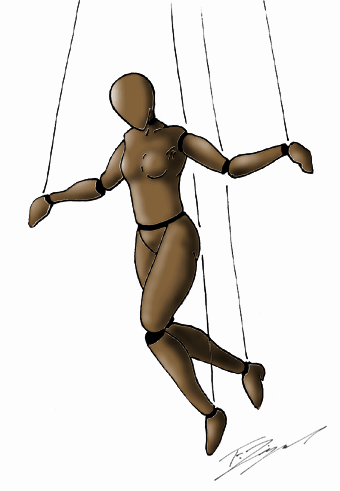
puppetry
After, we did character creation, where we worked with a different partner and manipulated them into the position of an old man/old woman. We had to imagine that we were pulling certain parts of our partners body. This task seemed like puppetry to me as it almost felt as if we were controlling them when manipulating them. We created the physicality of block characters which included: A capitalist; who was rich and fat, a pregnant lady; who was drunk, party goers; who were champagne drunk, and rowdy drunk people. Most of the character's personality was seen through the physicality which related to the Brechtian style of acting, in which he says you should narrate the actions/gestures of the actor.

We also found out the topic of our play which is race and immigration. Therefore I have done some research about how people can avoid immigration in the USA. This can be done by applying for a Green Card where you will then become an American citizen once applied. I found out some of the information from this website:  http://www.immigrationdirect.com/?r=ga-cpc-imm_world-immigration_usa:m=e&gclid=CPmOn--I07oCFbLJtAodCzwAwQ


Theatre Log Book Term 2 - November 4th 2013

Today I learnt about the Brecht technique called 'Verfremdungseffekt' also known as the 'V' effect. Verfremdungseffekt is a German word which means 'alienation effect', and this means to create strange making, distancing or alienating. This action/technique is to de-familiarise and remind actors that it isn't reality, and that there isn't a 4th wall between the audience and the actors. For example, during a performance, part of the production could be the audience watching the actors warm up and prepare to perform, or it could be that the actors are totally opposite to the role they are given. Furthermore, another 'V' effect could be the actors having direct contact with the audience. This technique could work quite well to make a performance comical, or on the other hand it can make a performance quite intense as the audience are indulged in the same world as the actors, they are part of it too.
 From doing my own research and learning a bit about the 'Brechtian technique' and the 'Verfremdungseffekt', I now have more understanding of what the purpose of this technique was. Therefore I can adapt to these techniques and improve my knowledge about it from here.


The 'V' effect is used to highlight part of a play that you want the audience to be aware of such as thoughts and actions, which will leave them with questions. This could be used to represent the main themes of a play which would be shown to the audience.
A quote that Brecht said was: 'The actors/artist never act as if there's a 4th wall. He expresses his awareness of being watched. The audience can no longer have the illusion of being the unseen spectator at an event which is really taking place'.

A link I found on YouTube had a quite interesting and more in-depth introduction about the Brechtian technique, which has expanded my knowledge about this.