In today's lesson, we were put in groups in which we have to stay in for our 'Alice In Wonderland' performance.
When in our groups, we had to choose a significant scene from the 'Alice In Wonderland' film and begin devising a piece that could be used in our future performance.
My group and I decided to do the scene in which Alice falls down the hole. Relating it to the 'Theater of Cruelty' ideology, we had to experiment with ways in which we could include and weird the audience out.
In this case, my group and I decided to include taboo topics in our devised piece.
Taboo topics aren't usually spoken about, therefore my group and I thought that it would be a good idea to include Artaud theater by merging in themes of drugs and sex in our performance.
Additionally, another Artaud theme we included in our devised piece was beginning our performance in the audience, this way, the audience are already part of the performance rather than sitting back and watching it. Also, our audience are stood up for our performance therefore, they can't get as comfortable as they would in a traditional theater.
I think it is important that our performance is a travelling piece, so that the audience are moving, exploring and experimenting as much as possible. Artaud wanted to connect the audience and the actors as much as possible, therefore it is also important that we include these Artaudian themes throughout our performance, to break the rules and conventions of a traditional theater.
Thursday, January 30, 2014


Monday, January 27, 2014
Theater Log Book Term 3 - January 21st 2014
In today’s lesson, we looked at breaking taboos in terms of subject matter and in terms of conventions and staging.
When working with Artaud's theater ideology, it is very important to consider the staging and conventions as Antonin Artaud liked to stage his performances in such ways that included the audience.
As a class, we were asked to create a world where everything was exactly as someone wanted it to be, and in my group we created a world where there was a king who demanded everything to be done perfectly, otherwise if done wrongly the servants would be thrown into a cage.
Doing this exercise and seeing all the other ideas from the other groups allowed me to see how any world could be created. This sort of reminded me of Artaud's way of creating immersing and surrealist theater, because it was almost like we had created a world which could possibly only exist in dreams, mixed with some elements of reality.
Then, we did an exercise in pitch darkness which required us to all rely on just our senses. This is a very Artaud way of immersing the audience into performances, because at this point they can't see what they're doing and they are extremely vulnerable to the actors. In the middle of the circle that we'd created, there was a telephone, and with that telephone we each had to make a threatening phone call using either dialogue or even just sounds. From doing this exercise, I learnt that any specific type of atmosphere can be created even without visuals, but in fact the atmosphere can be built by just being in complete darkness. At this point I felt the atmosphere seemed quite scary and tense, and from my own knowledge of understanding, this is how Antonin Artaud would want his audience to feel. This use of catharsis to me is extremely effective because at the time I felt the way that I believe I was meant to feel, which made it much more interesting and immersing.
When working with Artaud's theater ideology, it is very important to consider the staging and conventions as Antonin Artaud liked to stage his performances in such ways that included the audience.
As a class, we were asked to create a world where everything was exactly as someone wanted it to be, and in my group we created a world where there was a king who demanded everything to be done perfectly, otherwise if done wrongly the servants would be thrown into a cage.
Doing this exercise and seeing all the other ideas from the other groups allowed me to see how any world could be created. This sort of reminded me of Artaud's way of creating immersing and surrealist theater, because it was almost like we had created a world which could possibly only exist in dreams, mixed with some elements of reality.
Then, we did an exercise in pitch darkness which required us to all rely on just our senses. This is a very Artaud way of immersing the audience into performances, because at this point they can't see what they're doing and they are extremely vulnerable to the actors. In the middle of the circle that we'd created, there was a telephone, and with that telephone we each had to make a threatening phone call using either dialogue or even just sounds. From doing this exercise, I learnt that any specific type of atmosphere can be created even without visuals, but in fact the atmosphere can be built by just being in complete darkness. At this point I felt the atmosphere seemed quite scary and tense, and from my own knowledge of understanding, this is how Antonin Artaud would want his audience to feel. This use of catharsis to me is extremely effective because at the time I felt the way that I believe I was meant to feel, which made it much more interesting and immersing.
Theater Log Book Term 3 - January 20th 2014
 Peter Brooks believed that ‘the problem of the
Deadly Theater is like the problem of the deadly bore’. His ideology was that Deadly theater can at first sight be taken for granted because it means bad theater.
Peter Brooks believed that ‘the problem of the
Deadly Theater is like the problem of the deadly bore’. His ideology was that Deadly theater can at first sight be taken for granted because it means bad theater.Peter Brooks liked to challenge the traditional theater, by going against it's usual morals. He said that 'I can take any empty space and call it a bare stage. A man walks across this empty space whilst someone else is watching him, and this is all that is needed for an act of theater to be engaged'. In other words, he believes that from human experience, there cannot be an empty space with no meaning or feeling towards it. In this case he would create a piece of theater in places that many people wouldn't consider a performing stage.
He said that Deadly Theater never meant dead: but it meant something depressingly active, in this case very capable of change.
In many ways Peter Brooks was thoroughly inspired by Artaud's 'Theater of Cruelty' ideology. He wanted to also break down the fourth wall between the actors and the audience, by creating weird immerse theater.
Peter Brooks asked questions such as Why do we applaud, and what? Has the stage a real place in our lives? What function can it have? What could it serve? What could it explore? And, what are its special properties? Peter Brooks wanted to be able to answer all of these questions through theater, and including the first steps of change which is facing the simple unattractive fact that most of what is called theater anywhere in the world is a travesty of a world once full of sense, combining war, peace and a colossal bandwagon of culture onto stage.
In relation to Antonin Artaud's theory, he wanted to include the idea of 'reality being a world with many meanings'. Peter Brooks said that 'the closeness of reality and the distance of myth, because if there is no distance, you aren't amazed, and if there is no closeness, you aren't moved'. This relates to Antonin Artaud's theory because from what I've learnt about him, he used to take several drugs in order to get entry into other sealed off worlds, and to hallucinate and experience dreams in reality. This was called surreal theater, in which dreams are combined with reality, which allowed the audience to experience a different type of reality.
Artaud believed that theater loses its power and ability to communicate when it attempts to be literary (naturalism), it doesn't change us. He wanted a theater that would exercise us, so that we are changed on a deeper level, a theater beyond the barriers of rational intellect, not just entertainment, wanted something more like a religious experience, exploring the inner world of man. He influenced Peter Brooks who speaks of the responsibility of the audience, and combining the spectators and the audience together.
Tuesday, January 14, 2014
Theater Log Book Term 3
Today, we created several experiments which were related to the Antonin Artaud's 'Theater of Cruelty' theory.
Firstly, in groups we were given all given sheets that had a public place in which the norms of that place could easily be broken.
My group was given a library as our setting, and we listed several ways in which the norms of that place could be broken, some of which were: eating & drinking, playing loud music, talking loudly, vandalizing and so on.
Therefore, another group pretended to be ordinary people in a library, and my group was to come and go against every law of the facility. We performed by pretending to eat, drink, talk loudly and vandalize.
From my own experience I found this quite fun and interesting, as I found it appealing to me how the audience reacted. I discovered that the other group taking part in our role play seemed uncomfortable so some of them just laughed out of role, and also the audience found it quite funny. In relation to the 'Theater of Cruelty', I can see this being something that Antonin Artaud would use in one of his performances, as he liked to make the audience feel slightly uncomfortable, implying that they are also part of the performance (breaking down the 4th wall). Additionally, Artaud did also like comedy, and considering our audience found our role play of breaking the norms quite comedic, I think that this would be a good way of showing our knowledge of Antonin Artaud's preferences for our future performance.
Next, we then did an exercise where we do free writing, which is where we just write anything down that comes straight to our mind first without thinking. The pen is just writing whatever it feels! In different groups we then chose one of those words and we acted it out using just sounds and physicality. From doing this I learnt that I can communicate a word/phrase to an audience without literally speaking. Artaud believed that actions and sounds spoke louder than words, and that words was often so misused in the wrong way, loosing their true meaning.
We then thought of taboo issues that aren't often discussed in the world and we had to put this topic into role play, my group's topic was on child abuse and abusive relationships.
Afterwards, we then went into different groups and did an Artaud themed experiment on the whole class. We were all to sit tightly packed together in pitch darkness, whilst a group would then have to make sounds which represented their character in their taboo topic role play. From being part of this experiment I found it quite scary as I relied totally on my senses which at the time was hearing. Antonin Artaud enjoyed the thought of the audience using their senses, as it triggered a different sort of reliability on our senses, rather than relying on vision which we are used to using every day. When my group went to switch roles, I found it really fun being the sound maker, expressing the way my character in the role play may have felt. I imagined my character felt angry wanting to escape her abusive relationship, therefore I did a growling sound which shocked and scared the audience. This use of catharsis got the audience feeling terror and fear, therefore I learnt that this experiment that we tried out would be a good way of portraying the 'Theater of Cruelty' theory during our future performance.
Firstly, in groups we were given all given sheets that had a public place in which the norms of that place could easily be broken.
My group was given a library as our setting, and we listed several ways in which the norms of that place could be broken, some of which were: eating & drinking, playing loud music, talking loudly, vandalizing and so on.
Therefore, another group pretended to be ordinary people in a library, and my group was to come and go against every law of the facility. We performed by pretending to eat, drink, talk loudly and vandalize.
From my own experience I found this quite fun and interesting, as I found it appealing to me how the audience reacted. I discovered that the other group taking part in our role play seemed uncomfortable so some of them just laughed out of role, and also the audience found it quite funny. In relation to the 'Theater of Cruelty', I can see this being something that Antonin Artaud would use in one of his performances, as he liked to make the audience feel slightly uncomfortable, implying that they are also part of the performance (breaking down the 4th wall). Additionally, Artaud did also like comedy, and considering our audience found our role play of breaking the norms quite comedic, I think that this would be a good way of showing our knowledge of Antonin Artaud's preferences for our future performance.
Next, we then did an exercise where we do free writing, which is where we just write anything down that comes straight to our mind first without thinking. The pen is just writing whatever it feels! In different groups we then chose one of those words and we acted it out using just sounds and physicality. From doing this I learnt that I can communicate a word/phrase to an audience without literally speaking. Artaud believed that actions and sounds spoke louder than words, and that words was often so misused in the wrong way, loosing their true meaning.
We then thought of taboo issues that aren't often discussed in the world and we had to put this topic into role play, my group's topic was on child abuse and abusive relationships.
Afterwards, we then went into different groups and did an Artaud themed experiment on the whole class. We were all to sit tightly packed together in pitch darkness, whilst a group would then have to make sounds which represented their character in their taboo topic role play. From being part of this experiment I found it quite scary as I relied totally on my senses which at the time was hearing. Antonin Artaud enjoyed the thought of the audience using their senses, as it triggered a different sort of reliability on our senses, rather than relying on vision which we are used to using every day. When my group went to switch roles, I found it really fun being the sound maker, expressing the way my character in the role play may have felt. I imagined my character felt angry wanting to escape her abusive relationship, therefore I did a growling sound which shocked and scared the audience. This use of catharsis got the audience feeling terror and fear, therefore I learnt that this experiment that we tried out would be a good way of portraying the 'Theater of Cruelty' theory during our future performance.
Monday, January 13, 2014
Theatre Log Book Term 3
Antonin Artaud wanted to break down barriers between people, and in order to apply the breaking down of the fourth wall to our future performance, in the future we will set up experiments which will terrify the audience. For example, by stimulating the audiences senses.
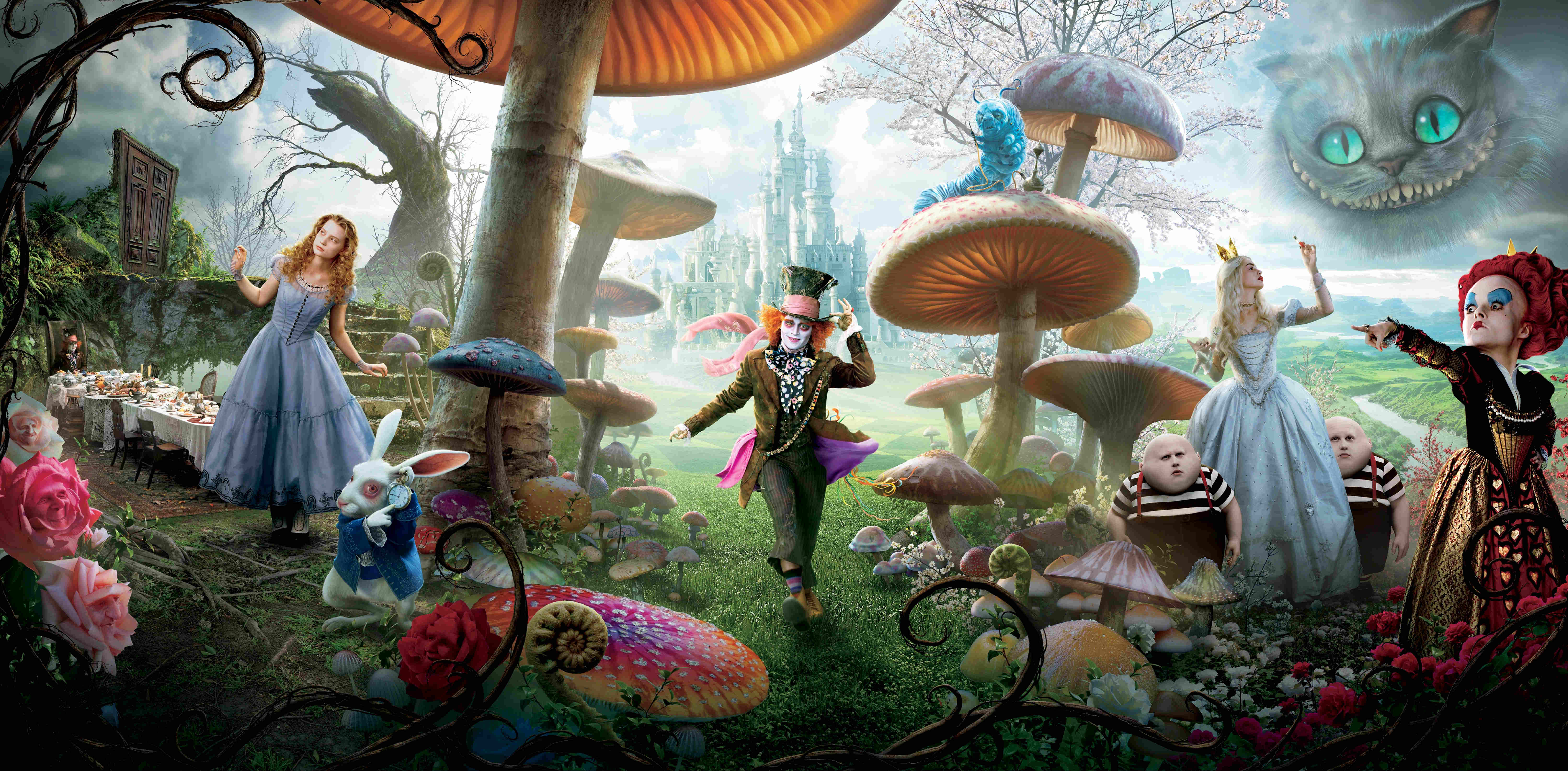 Our stimulus for our performance is 'Alice in Wonderland'. This film includes lots of fictional and non-realistic characters. There are several colors used throughout and several events that relate to surrealism. It is almost a cross between reality and dreams, as it's somewhat like a dream world or a world from 'Alice's illusions. This relates to Artaud's theater ideology, therefore it is a good stimulus to to link and relate to the 'Theater of Cruelty'.
Today, on a piece of paper we wrote things down which had to to with being 'English'.
 We then chose one of those ideas down and has to represent it physically with our bodies and by using sound. The word we chose from our list was a phone box. By doing this exercise I learnt that a small piece of physicality can be created by using a stimulus, in our case which was the topic of 'being English'.
What do I see when Alice falls down the rabbit hole?
When Alice falls down the rabbit hole, there are several floating objects such as a lamp, piano, mirror, a book case, flowers, clocks, rocking chairs, and a picture. I also notice that from her facial expressions she is shocked and also quite curious about the items that are floating and surrounding her.
What does she see and do (Aspects of English-ness)?
At first she examines the hole that she is in and she observes all of the floating objects that is within the space. For example she switches on the lamp. Relating this to aspects of 'English-ness', it is usual for a British person to be curious when around things that they are unfamiliar with, for example if someone from the countryside and valleys of England came to the city of London, they would be curious to see and examine all the new surroundings that they are not familiar with. On the other hand it could also slightly intimidate them too, as in 'Alice in Wonderland' she seems quite shocked and wary at the same time which shows in her facial expressions.
Lastly, in class we brainstormed another circumstance which could have happened when Alice fell through the hole, and my group and I came up with the idea that the place is actually owned by hierarchy (the queen) who are bad people, therefore she somehow has to escape which then leads on to the rest of her adventure.
Overall from this lesson I can see different ways in which we can develop our ideas of a scene just by using a stimulus and relating it to the topic of 'being English', whilst linking it to Artaud's 'theater of cruelty' theory.
Theater Log Book Term 3 - January 6th 2014
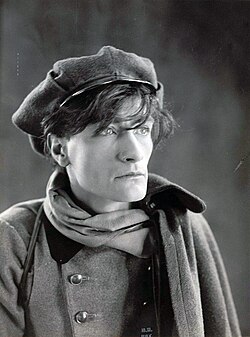
Antonin Artaud was a theater practitioner born on the 4th September 1896 and died on the 4th March 1948. He was a french playwright, poet, actor and a theater director.
 Her theater practitioner theory was the 'Theater of Cruelty'. Artaud believed that theater should be able to communicate to the audience and represent reality. Therefore, he wanted her theater creations to affect the audience as much as possible. From my own understanding his theory was similar to Brecht's idea, in the terms of the 'verfremdungs' effect (alienating the audience), whilst breaking down the 4th wall that stands between the audience and actors in traditional theaters. In contrary his ideology was to create reality on stage whereas Bertolt Brecht wanted to create as much fiction as possible by exaggerating stereotypes. In this case I could say in some ways he's also similar to Konstantin Stanislavsky as he wanted to show project reality on stage.
Despite the fact, in Artaud's way of creating reality, he wanted to tap into the subconscious mind, therefore, the surrealist used to take drugs to experience illusions that he would then use and share as ideas for the theater. His influence from this strange type of reality was from when he moved to Paris in March 1920. After the world war one, the society had to redefine the reality of the countries, therefore some of Artaud's inspiration came from the idea of combining reality with dreams in order to create a surreal reality. These situations that Antonin Artaud experienced probably influenced him to also discover his talent for 'avant-garde' theater. The 'avant' works are experimental or innovative with the respect to art, culture, and politics. However, it pushes the boundaries of what is accepted as a 'norm' or 'status-quo'. Artaud believed that movement and gestures spoke louder than words, which meant that he chose to create theater with minimal text. He also used combination of distorted forms of lighting, sounds and other performance elements.
In order to create the Theater of Cruelty, Antonin Artaud wanted to combine surrealism and metaphysics. He wanted the world we see in our dreams which are a fantasy mixed with reality and combining it with the understandings of the world, such as existence, general objects and their properties, space, time, cause and effect, and possibility.
The main investigation into metaphysics is 'ontology' which focuses on basic categories of being and how they relate to each other. Another branch is 'cosmology', which is the study of origin, fundamental structure, nature and dynamics of the universe.
Antonin Artaud reassessed the spectator actor relationship and all the rules of a traditional theater. This could include a different stage, such as performing in traverse or in a round instead of traditionally where the audience watch the stage in front above them. Also by breaking down the 4th wall between the audience and actors, Artaud may have included audience interaction or direct address too!
Comedy was one of Antonin Artaud's interests which I believe could have had an influence on his type of performances, signifying that he may have made many of them comedic or with a funny light side towards some of them!
Overall, Antonin Artaud used 'Total Theater' in his work which means that it includes every aspect of theater possible. Additionally, he used 'Catharsis' which is when emotions are let out through art, specifically pity or fear, or any extreme change in emotion that results in renewal and restoration. Antonin's Theater of Cruelty has been created in order to restore to the theater a passionate conception of life.
 Her theater practitioner theory was the 'Theater of Cruelty'. Artaud believed that theater should be able to communicate to the audience and represent reality. Therefore, he wanted her theater creations to affect the audience as much as possible. From my own understanding his theory was similar to Brecht's idea, in the terms of the 'verfremdungs' effect (alienating the audience), whilst breaking down the 4th wall that stands between the audience and actors in traditional theaters. In contrary his ideology was to create reality on stage whereas Bertolt Brecht wanted to create as much fiction as possible by exaggerating stereotypes. In this case I could say in some ways he's also similar to Konstantin Stanislavsky as he wanted to show project reality on stage.
Despite the fact, in Artaud's way of creating reality, he wanted to tap into the subconscious mind, therefore, the surrealist used to take drugs to experience illusions that he would then use and share as ideas for the theater. His influence from this strange type of reality was from when he moved to Paris in March 1920. After the world war one, the society had to redefine the reality of the countries, therefore some of Artaud's inspiration came from the idea of combining reality with dreams in order to create a surreal reality. These situations that Antonin Artaud experienced probably influenced him to also discover his talent for 'avant-garde' theater. The 'avant' works are experimental or innovative with the respect to art, culture, and politics. However, it pushes the boundaries of what is accepted as a 'norm' or 'status-quo'. Artaud believed that movement and gestures spoke louder than words, which meant that he chose to create theater with minimal text. He also used combination of distorted forms of lighting, sounds and other performance elements.
In order to create the Theater of Cruelty, Antonin Artaud wanted to combine surrealism and metaphysics. He wanted the world we see in our dreams which are a fantasy mixed with reality and combining it with the understandings of the world, such as existence, general objects and their properties, space, time, cause and effect, and possibility.
The main investigation into metaphysics is 'ontology' which focuses on basic categories of being and how they relate to each other. Another branch is 'cosmology', which is the study of origin, fundamental structure, nature and dynamics of the universe.
Antonin Artaud reassessed the spectator actor relationship and all the rules of a traditional theater. This could include a different stage, such as performing in traverse or in a round instead of traditionally where the audience watch the stage in front above them. Also by breaking down the 4th wall between the audience and actors, Artaud may have included audience interaction or direct address too!
Comedy was one of Antonin Artaud's interests which I believe could have had an influence on his type of performances, signifying that he may have made many of them comedic or with a funny light side towards some of them!
Overall, Antonin Artaud used 'Total Theater' in his work which means that it includes every aspect of theater possible. Additionally, he used 'Catharsis' which is when emotions are let out through art, specifically pity or fear, or any extreme change in emotion that results in renewal and restoration. Antonin's Theater of Cruelty has been created in order to restore to the theater a passionate conception of life.
Subscribe to:
Posts (Atom)